Smudge Test for Sanitaryware Product: Method & Criteria
CeramicNinja2 min read36 views
Smudge Test for Sanitaryware Product: Method & Criteria
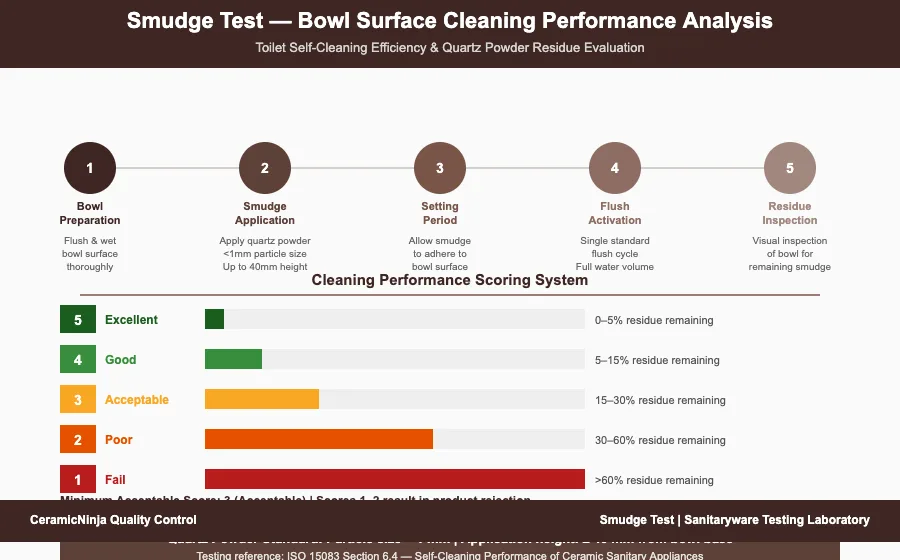
The Smudge Test checks how well a toilet can clean waste that has stuck or smudged onto the inner bowl surface during flushing. In real use, waste material can sometimes stick to the bowl walls. A good quality toilet should be able to flush it away cleanly in a single flush, leaving no residue behind.
This test simulates that condition in the factory using quartz powder as the test material.
Test Procedure
Flush the toilet and thoroughly wet the entire inner bowl surface.
Apply a thin, even layer of quartz powder (particle size smaller than 1 mm) under the toilet rim, up to a height of approximately 40 mm from the rim downward.
Flush the toilet once.
Inspect the entire inner bowl surface carefully for any remaining quartz powder.
Acceptance Criteria
After flushing, there should be no traces of quartz powder remaining anywhere inside the bowl. If even a small amount of powder is left behind, it means the toilet's flushing pattern is not covering that area properly and the product fails the test.
Why This Test Matters
If a toilet cannot clean a light smudge of powder in one flush, it will struggle to clean actual waste in real use. This leads to unhygienic bowls, visible staining, and customer complaints. Running this test in the factory ensures that every toilet that goes out has strong, full-coverage flushing performance.
Share this article
Written by
CeramicNinja
Ceramic industry professional & content contributor.
Leave a Comment
Add your comment
No comments yet. Be the first to share your thoughts!
Earlier read
Splash Test for Sanitaryware Product: Method & Analysis
Next read
Saw Dust Flush Test Method for Sanitaryware Product
Keep exploring
Practical articles, Buy/Sell listings, and jobs