Saw Dust Flush Test Method for Sanitaryware Product
CeramicNinja2 min read32 views
Saw Dust Flush Test Method for Sanitaryware Product
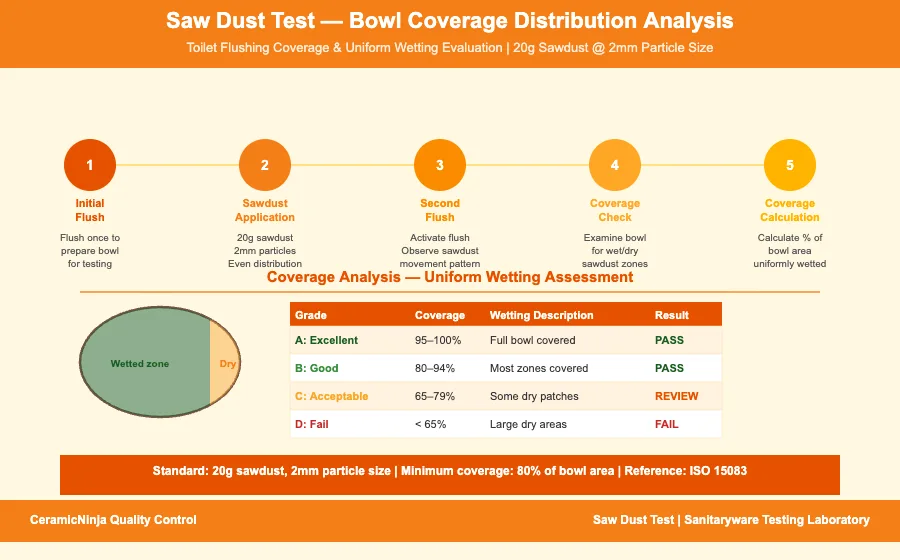
The Saw Dust Flush Test is done to check how well the toilet's flushing water covers and cleans the inner bowl surface, particularly the area just below the rim. This test is mainly used during new product design validation or for batch-level quality audits. It is not done on every individual piece coming off the production line.
The goal is to verify that the flushing water reaches and cleans the critical zone below the rim where waste and stains can accumulate in real use.
Test Material
Sawdust quantity: 20 grams
Particle size: 2 mm
Test Procedure
Flush the toilet once to wet and prepare the bowl surface.
Evenly sprinkle the 20 grams of sawdust inside the bowl, spreading it up to the water level.
Flush the toilet once again.
Inspect the bowl carefully for any sawdust remaining in the area 40 mm below the rim.
Acceptance Criteria
All sawdust in the zone up to 40 mm below the rim must be completely cleared after flushing. If any sawdust remains in this zone, it means the flushing water is not covering that area adequately.
Since this is a design and process validation test and not a piece-by-piece rejection test, a failure here does not mean the product is scrapped. Instead, the production or design team is informed to investigate and improve the rim design, glaze finish, or flushing mechanism to ensure proper water coverage.
Why This Test Matters
The area just below the rim is one of the hardest spots to clean in a toilet. If flushing water does not reach there properly, waste and stains will build up over time in the field. By testing this during design validation and batch audits, factories can catch and correct issues early before they become widespread field complaints.
Share this article
Written by
CeramicNinja
Ceramic industry professional & content contributor.
Leave a Comment
Add your comment
No comments yet. Be the first to share your thoughts!
Earlier read
Smudge Test for Sanitaryware Product: Method & Criteria
Next read
Single Ball Test for Sanitaryware Product: Method & Analysis
Keep exploring
Practical articles, Buy/Sell listings, and jobs