Dunting Defect in Ceramic Manufacturing - Overview
CeramicNinja2 min read61 views
Understanding Dunting in Ceramics
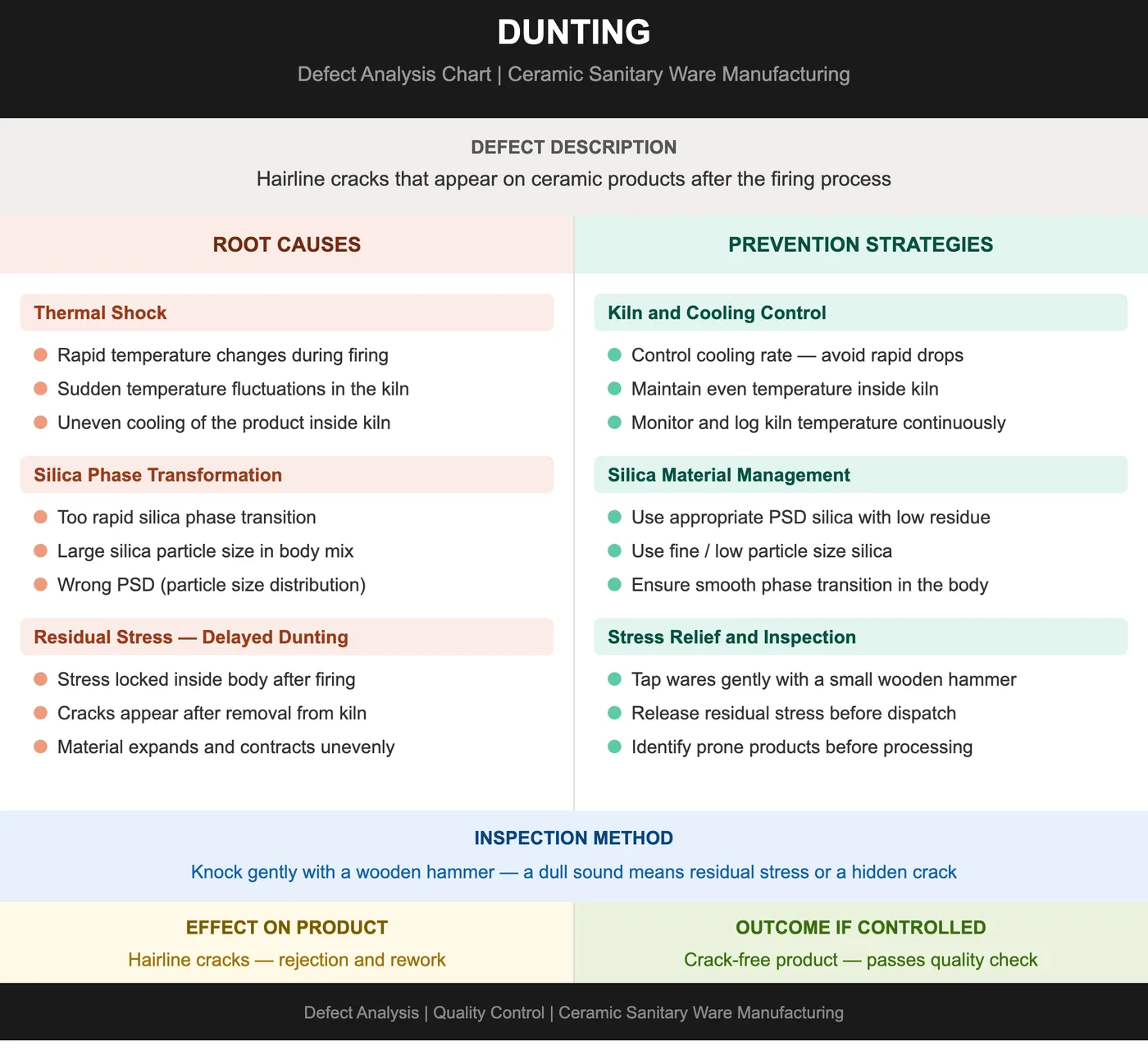
Dunting refers to the formation of hairline cracks that appear on ceramicproducts after firing.
Causes of Dunting
The primary cause of dunting is thermal shock during the firing process, where rapid changes in temperature lead to stress on the ware, causing it to crack. This stress is often due to:
Uneven cooling of the product
Sudden temperature fluctuations inside the kiln
These thermal changes cause the material to expand and contract at different rates, resulting in the formation of small cracks.
Delayed Dunting
In some cases, delayed dunting can occur after the product has been removed from the kiln, where cracks appear later due to residual stress in the material.
Inspection and Stress Relief
To address this issue, manufacturers often perform a stress-relieving process. During inspection, a small wooden hammer is used to gently knock on the wares, which helps to release any residual stress that might cause cracking. This technique can help identify products that are prone to dunting before they are sent out for further processing or shipment.
Silica Phase Change and Particle Size
A major contributor to dunting is the stress created during the silica phase trasfermation. If the transition is too rapid or if the silica particles are too large, it can lead to cracks. Finer silica particles can transition through the phase change more smoothly, without creating excessive stress inside the body of the product.
Prevention Strategies
To prevent dunting, manufacturers should focus on:
Controlling the cooling process in the kiln to avoid rapid temperature changes
Using appropriate PSD silica with low residue
Employing low particle size silica to ensure minimal residue
Share this article
Written by
CeramicNinja
Ceramic industry professional & content contributor.
Leave a Comment
Add your comment
No comments yet. Be the first to share your thoughts!
Earlier read
Colour Fading Defect in Ceramics: Causes & Analysis
Next read
Crazing Defect in Ceramics: Causes, Analysis & Prevention
Keep exploring
Practical articles, Buy/Sell listings, and jobs