


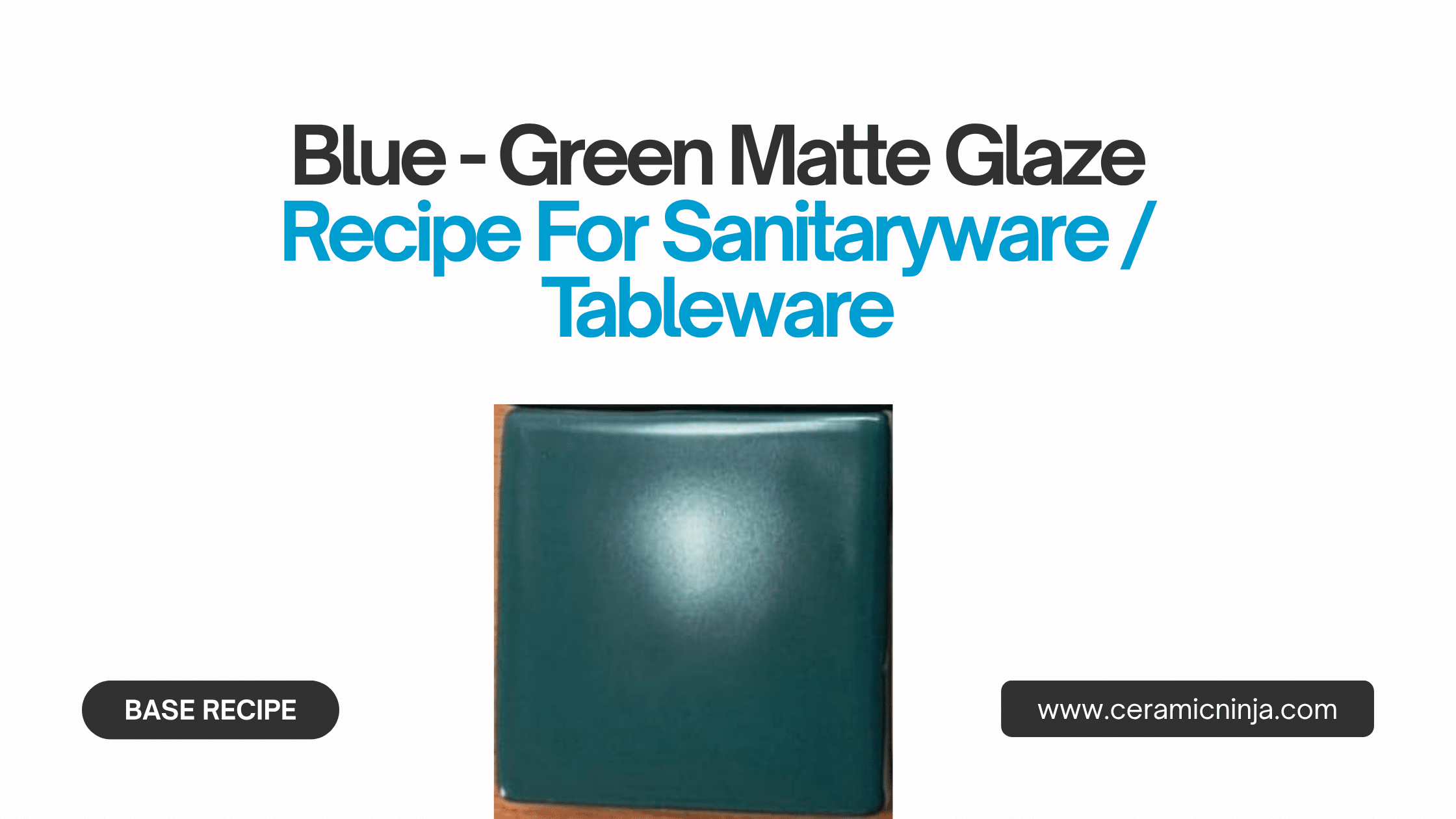
Blue-Green matte glaze in sanitaryware is one of the most challenging finishes to achieve consistently. The final appearance depends heavily on the firing curve, oxidation conditions, and raw material interactions.
This article provides a base formulation that can be used as a starting point for developing a stable blue-green matte glaze. Further fine-tuning is required based on plant conditions.
Note: Blue-Green matte glaze development is highly sensitive to firing profile and kiln atmosphere.
Small adjustments can significantly impact the final surface.
Base Blue-green Matte Glaze Formulation
| Raw Material | Percentage (%) |
|---|---|
| Potash Feldspar | 45% |
| Soda Feldspar | 05% |
| Quartz | 20% |
| Calcite | 15% |
| China Clay | 03% |
| zinc | 03% |
| Barium | 05% |
| Talc | 13% |
| Alumina | 3.5% |
Additives
| Additive | Percentage (%) |
|---|---|
| CMC | 0.5% |
| Stain | 5.5% |
Key Development Considerations
- Maintain consistent firing temperature and soaking time.
- Control oxidation conditions carefully during firing.
- Fine-tune stain percentage for depth of blue-green shade.
- Monitor glaze thickness during application.
Conclusion
This formulation should be used as a starting base for developing a blue-green matte glaze in sanitaryware applications. Due to variations in raw materials and kiln conditions, it is essential to perform plant-level trials and optimize accordingly.
Practical Tip: Always validate the glaze through lab trials before full-scale production
to avoid defects such as uneven matte finish or color variation.





Post Comment