


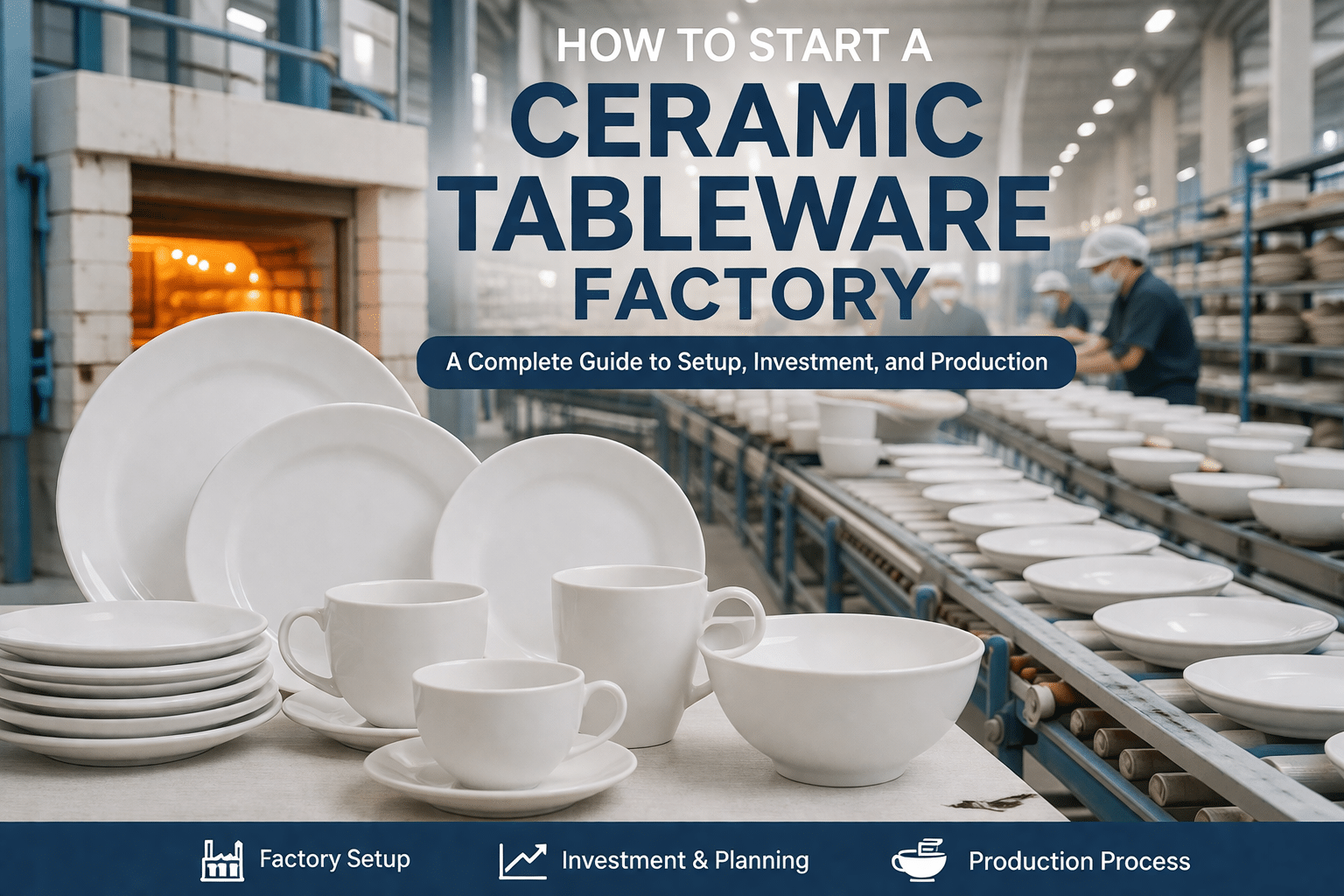
Starting a ceramic tableware factory can be a good business opportunity if it is planned properly. Before making the final decision, it is important to understand the technical, financial, and production-related points involved in this industry.
Many people think ceramic tableware manufacturing is simple, but it requires proper planning in raw materials, machinery, kiln selection, product choice, and factory layout. If these areas are not planned correctly, the factory may face high rejection, high cost, and low profitability.
This article explains the important things you should consider before starting a ceramic tableware factory.
Raw Materials Required
The first thing to understand is the raw materials used for making ceramic tableware. The main body raw materials are usually ball clay, china clay, feldspar, and quartz. These materials are selected and mixed based on the type of body you want to produce.
For glaze, you can either buy ready-made glaze compounds or prepare glaze in your own factory. For a small factory, ready-made glaze may be easier to start with. For larger production, in-house glaze preparation can help control cost and quality better.
Investment Required
One of the most common questions is how much investment is needed to start a ceramic tableware factory. A small factory can be started with around ₹25,00,000, but this cost can vary depending on the level of automation, type of kiln, and production capacity.
Important: In most cases, the kiln is the biggest investment item in the factory.
If you go for more manual methods, the initial investment can be lower. If you choose more automation and larger capacity, the investment will increase.
Type of Ceramic Tableware to Manufacture
Before starting, you must decide what kind of ceramic tableware you want to produce. Not all tableware products are the same, and different bodies require different raw materials, firing temperatures, and production methods.
Common options include porcelain, stoneware, bone china, and earthenware. Your product choice should depend on your target market, quality level, and investment capacity.
Manufacturing Process
The ceramic tableware manufacturing process starts with body preparation or slip preparation. After that, the products are shaped using suitable forming methods such as casting, jiggering, or jollying.
Once the products are formed, they are dried properly and then glazed. If decoration is required, it is done before or after firing depending on the design and production system. After firing, the products are sorted, inspected, and packed.
Kiln Selection
Kiln selection is one of the most important decisions when starting a ceramic tableware factory. The kiln affects product quality, fuel cost, production capacity, and overall running cost of the factory.
Shuttle kilns and tunnel kilns are commonly used in this industry. Shuttle kilns are more flexible and suitable for smaller production, while tunnel kilns are generally more suitable for larger production and better energy efficiency.
Space Required for the Factory
Factory space depends on your daily production target and production flow. If you are planning to produce around 1,000 pieces per day, you may need around 2,500 square feet as a basic starting area.
However, the actual space required will depend on raw material storage, slip preparation, forming area, drying section, glazing area, kiln section, and packing area. A proper layout is very important for smooth production.
Workers Required
The number of workers required depends on the level of automation and the type of products you plan to manufacture. For a small unit producing around 1,000 pieces per day, around 25 workers may be required.
This number can vary based on your forming process, handling system, and factory layout. Skilled workers and proper supervision are important to reduce defects and improve productivity.
Production Capacity and Profitability
If you are planning to start a factory, it is better to think about production capacity from the beginning. A very small production level may not always give a good profit after covering standard operating costs.
In general, if you are able to produce around 3 to 4 tonnes of products per day, the business may become more stable and profitable. But this also depends on your product type, selling price, rejection level, and market demand.
Production Cost
The production cost of ceramic tableware depends on several factors. The main cost areas are raw materials, glaze, fuel, power, labour, and maintenance.
Apart from these, rejection percentage also has a major impact on cost. The final production cost will depend on the type of products you make and the quality level you maintain in the factory.
Rejection in Ceramic Tableware Production
Rejection is a normal part of ceramic production, especially in tableware where appearance and finish are very important. Typically, you may expect around 10% rejection in ceramic tableware production.
This can vary depending on the body quality, glaze quality, firing control, handling, and process discipline. Better technical control can help reduce rejection and improve profitability.
Market Position and Competition
Before starting the factory, you should clearly decide what value you want to bring to the market. You should know whether you want to compete on price, quality, design, or a combination of these.
This is important because your production system, quality level, and investment planning should match your market strategy. A factory without a clear market direction may struggle even if production is technically good.
Mistakes to Avoid
One common mistake is starting with too many products at the same time. It is always better to begin with a smaller and manageable product range, then expand later once the system becomes stable.
Another important mistake is selecting the wrong kiln or buying machinery without proper production planning. The kiln and equipment should be selected not only for current production but also for future expansion.
Improper factory layout is another major issue. Ceramic tableware products are sensitive to handling defects, so poor movement planning inside the factory can increase rejection and damage.
It is also a mistake to ignore glaze quality, whiteness, surface finish, and product appearance. In tableware, visual quality is very important because the customer notices it immediately.
Importance of Technical Planning
Before starting the factory, it is always better to prepare a complete project plan in written form. This should include investment, machinery, production capacity, layout, manpower, utilities, and expected production cost.
This kind of planning helps avoid unnecessary spending and wrong equipment selection. It also gives better clarity before you invest money into the project.
Hire a Ceramic Expert
One of the best decisions while starting a ceramic tableware factory is to take support from a ceramic expert. A good technical consultant can help you in body selection, glaze planning, kiln choice, machinery balance, and process setup.
This can save a lot of time, money, and production issues during the initial stage of the factory.
Conclusion
Starting a ceramic tableware factory is not only about buying machines and beginning production. It is a technical and business decision that requires careful planning in every area.
If you understand the raw materials, investment, kiln selection, process flow, manpower, and market clearly, you can build a more stable and profitable ceramic tableware business.
If you are planning to start a ceramic tableware factory, it is always better to plan correctly from the beginning rather than correcting costly mistakes later.
Need Technical Support?
If you are looking for technical support to start a ceramic tableware factory, feel free to contact me for consultancy.
Mobile/Whatsapp: +91 – 9500693318








Post Comment