


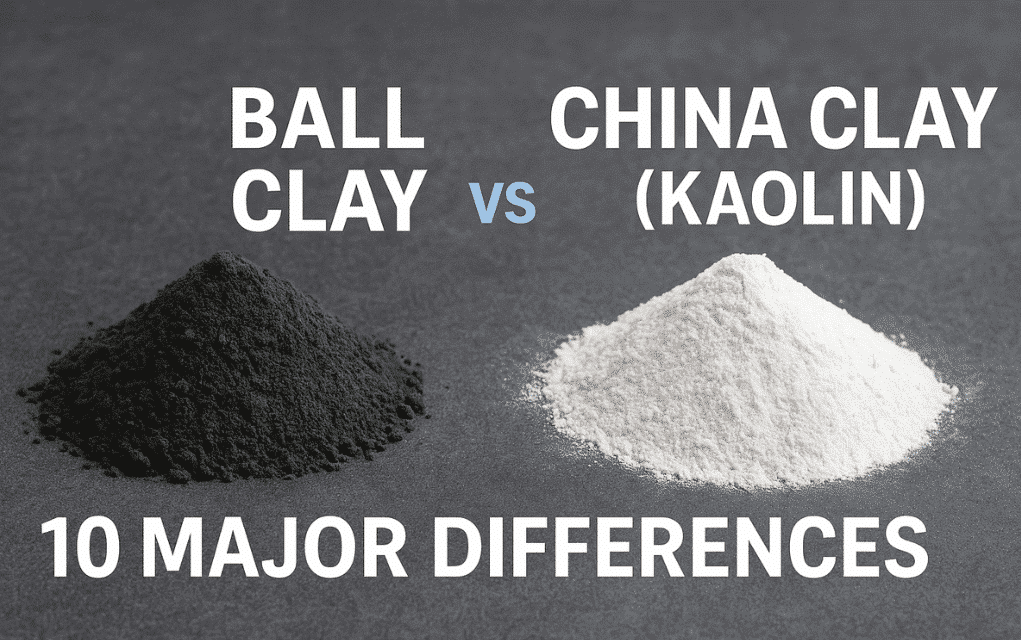
Clay is the major contributor to the dry and fired properties of the ceramic body. It is used in almost 60% of traditional ceramics. This clay is classified into two types: one is ball clay, and the other one is China clay (kaolin). Both clays have their strengths and weaknesses. Understanding the difference between these two clays is important to formulate a highly effective body.
Below are the 10 major property differences between ball clay and China clay (kaolin).
Origin:
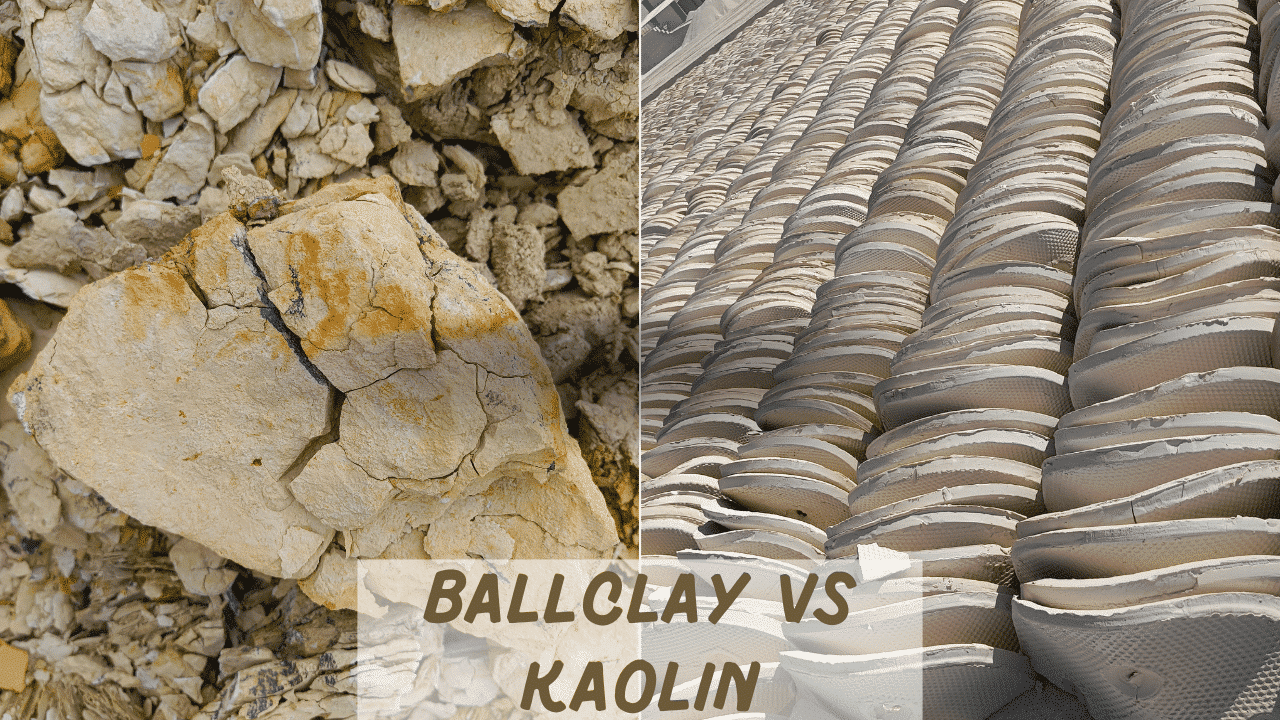
China clay (kaolin) is a primary clay, and it is formed during the weathering process of feldspar rocks. These China clay deposits are found in the same place of origin.
Ball clays are transported by water or other elements from the place of origin and deposited in a different place. This transportation makes the ball clay deposit more varied compared to the China clay.
This is the reason kaolin deposits have uniform properties, whereas the ball clay properties vary in different places within the same deposit.
Minerals:
Even though the major component of both clays is kaolinite, the percentage of kaolinite and other minerals varies in both clays. Below is the table comparing the mineral percentages in both clays.
| Mineral / Component | Ball Clay | China Clay (Kaolin) |
|---|---|---|
| Kaolinite | 40% – 60% | 70% – 90% |
| Silica | 30% – 40% | Less than 30% |
| Mica | Around 10% | minor |
| Feldspar/iron | traces | traces |
Impurities:
Because of the transportation of minerals, ball clay will have higher impurities compared to China clay.
Ball clay contains high organic compounds and impurities.
China clay contains few impurities and is comparatively pure.
Particle Size:
Ball Clay: Very fine-grained particles, giving it high surface area and plasticity. Low cast rate in the casting process. Low slaking property during slurry preparation
China Clay: Coarser particles compared to ball clay. High cast rate in the casting process. High slaking property.
Rheological Properties:
When preparing slips of both clays, the following common property is observed. This may vary in a few deposits.
- Ball Clay slip: Poor flow properties due to organic matter. Low slip stability and required higher deflocculant to make the slip flow better.
- China Clay slurry: Better flow behavior, making it easier to produce china clay slip. Low deflocculant demand and better stable slip properties.
Color:
Before firing, ball clay may be darker compared to China clay because of the organic impurities. After firing, it shows a dull or creamy color because of the impurities present in the ball clay.
China clay will have good whiteness before and after firing because of the low impurities present in the clay.
Workability:
Ball clay is more plastic and workable because of the finer particle size, and in a few deposits, colloidal carbon helps with this property as well. This property helps better shaping, extrusion, and densification processes.
China clay is comparatively low in plasticity because of coarser particles. To improve the workability of the kaolin, it will be blended with ball clay in the formulation.
Chemical component:
Chemical analysis of ball clay and China clay shows major differences in the silica and alumina content. Impurity components vary based on the deposit location.
| Chemical Component | Ball Clay | China Clay |
|---|---|---|
| Silica (SiO₂) | Around 55% | Around 50% |
| Alumina (Al₂O₃) | Around 25% | Around 35% |
Mechanical Strength:
Ball Clay: Higher dry modulus of rupture (MOR) due to finer particle size and packing density. Ball clay provides the body MOR to the product, like sanitaryware, tiles, and other ceramic manufacturing in the green stage.
China Clay: Lower dry MOR, but still contributes strength in ceramic body blends.
Other Properties:
Ball clay has lower LOI and water absorption compared to china clay (kaolin).
Conclusion:
Understanding ball clay and China clay is important in ceramic body formulation. They are added to the formulation based on the properties required for the body.
Ball clay is added where dry MOR, workability, plasticity, and better water absorption are required.
China clay is added for high casting rate, whiteness, chemical purity, and fired quality.







2 comments